
In this article
- The 8 Best Churn Management Software for 2026
- Top Subscriber Churn Management Software: Comparison & Ratings Chart
- 8 Best Subscriber Churn Management Software Solutions Reviewed
- The Limitations of Native Tools
- What Dedicated Solutions Provide
- The Convenience vs Performance Trade-Off
- When to Graduate from Native Tools
- How To Choose The Right Subscriber Churn Management Tool
- Final Thoughts
8 Best Churn Management Software in 2026
Check out the 8 best churn management software solutions for 2026. Discover our top picks and choose the right one for your business.
Choosing the best subscriber churn management software is crucial if you rely on recurring revenue. The right platform helps you understand why subscribers leave, predict who is at risk, and take action before churn becomes a revenue problem.
Good tools go far beyond basic analytics. They combine lifecycle data, billing signals, and engagement workflows so you can reduce cancellations, improve subscriber health, and protect revenue that would otherwise disappear.
The best of them also provide strategic expertise, not just another dashboard to stare at.
In this guide, we break down the 8 best subscriber churn management software tools for 2026, explain what each does well, and help you decide which solution fits your stage, stack, and strategy.
The 8 Best Churn Management Software for 2026
The best subscriber churn management platforms help you:
- Monitor and improve subscriber churn rate
- Predict churn risk and segment accounts intelligently
- Reduce both involuntary churn (failed payments) and voluntary churn (cancellations)
- Integrate with billing systems, CRMs, and product analytics
- Turn raw data into clear, actionable retention programs
We evaluated each platform based on:
- Core churn management capabilities
- Flexibility and customization
- Ease of setup and day-to-day use
- Reporting and analytics depth
- Integrations with Stripe, Shopify, and major subscription platforms
- Support quality and ongoing optimization help
- Expertise and strategic guidance, not just features
- Pricing model and realistic ROI potential
Below is a quick comparison chart, followed by in depth reviews.
Top Subscriber Churn Management Software: Comparison & Ratings Chart
*Pricing changes frequently. Treat this as directional and always confirm current plans on each vendor’s site.
8 Best Subscriber Churn Management Software Solutions Reviewed
1. Churn Buster

Churn Buster is a specialist in subscriber churn management for serious subscription businesses. It focuses on both passive churn from failed payments and active churn from cancellations, so teams can manage subscriber churn rate holistically instead of stitching together point solutions.
Founded in 2013, Churn Buster brings more than a decade of cross-vertical expertise—refined across 1,000+ subscription businesses spanning eCommerce (Shopify, Recharge, Loop, Skio) and B2B SaaS (Stripe). The platform combines sophisticated recovery and retention workflows with strategic guidance from retention experts who have refined playbooks across hundreds of businesses.
Churn Buster is ideal for companies that want a strategic retention partner rather than just another app to manage.
Beyond Software: Expert Guided Subscriber Churn Management
Churn Buster is intentionally positioned as strategic partnership plus software, not self serve tooling you set up once and forget.
Starting from basic setups, most companies see 10%+ recovery rate improvements right away, with median customer recovery rates around 50% and top performers reaching 80-90%+. Results vary by vertical—B2B SaaS businesses often achieve 80%+ recovery due to high customer intent, while eCommerce typically sees 40-60% due to lower purchase commitment. This typically delivers 10x+ ROI.
You get:
- Proven playbooks for both failed payment recovery and cancel flow optimization
- Quarterly strategy sessions to help you distinguish signal from noise when metrics move
- Vertical specific guidance for eCommerce subscriptions and B2B SaaS models
- Clear expectations about what is realistic based on your current baseline
Instead of guessing which experiments matter, you work with people who have seen what actually moves the needle.
This cross-vertical specialization is rare in the churn management space. Most tools focus exclusively on either eCommerce or B2B SaaS, but Churn Buster’s team has deep expertise in both—providing vertical-specific playbooks for eCommerce subscription brands while maintaining strong B2B SaaS capabilities. This means you get optimization strategies tailored to your business model, not generic advice.
Churn Buster Solves the Top Subscriber Churn Pain Points
Pain 1: Subscriber churn is treated as a billing issue only
Many teams treat churn like a billing or “payments” problem and ignore other churn vectors. That leads to fragmented projects, with one tool for declines and another for cancellations, plus manual work in support.
Churn Buster’s approach:
- Combines Dunning for failed payments with Cancel Flows for voluntary churn
- Connects billing events with lifecycle and engagement triggers
- Gives visibility into passive and active churn in a single view
This lets you manage subscriber churn rate as one retention system instead of two disconnected efforts.
Pain 2: Failed payments use one retry pattern for every decline
Native platform tools often run the same retry schedule no matter why a payment failed. Insufficient funds, expired cards, fraud blocks, and network errors all get the same timing, which leaves revenue on the table and annoys customers.
Churn Buster’s approach:
- Decline code specific retry logic rather than one ladder for all failures
- Adaptive retry timing based on millions of historic recovery data points
- Separation of “no contact needed” retries from “customer action required” flows
That means you recover a large share of soft declines automatically, while reserving communication for the cases where you truly need customers to act.
Pain 3: You cannot see where subscribers are leaking out of the funnel
Most subscription teams do not have visibility into which decline types are recoverable, which cancel reasons dominate, or which segments are at highest risk.
Churn Buster’s approach:
- Analytics that segment churn by decline code, plan, cohort, and channel
- Real time dashboards for recovery performance and cancel flow outcomes
- Transparent incremental lift measurement rather than vanity recovery numbers
You can finally answer “what actually worked” with confidence and invest in the strategies that produce real retention gains.
A Holistic Retention Engine: Passive And Active Churn Under One Roof
Churn Buster is one of the few platforms that addresses involuntary churn from failed payments and voluntary churn at cancellation in the same product. You get:
- Cancel Flows that surface personalized alternatives such as pausing, downgrades, or offer tests
- Dunning workflows that recover failed payments without unnecessary friction
- Testing capabilities across messaging, offers, and timing
For subscriber churn management, this holistic design matters. It prevents you from over optimizing one side of churn while ignoring the other.
Integrations and Support
Churn Buster integrates across your subscription stack, including:
- Stripe
- Shopify and Shopify Subscriptions
- Recharge, Loop, Skio, Smartrr, Awtomic, Subbly
- Braintree, PayPal, and other gateways
Support is intentionally high touch.
You get onboarding help, configuration reviews, deep strategy consultations, and ongoing optimization, rather than a ticket queue that only answers technical questions.
Pricing
Churn Buster pricing scales with subscription volume, which makes ROI easy to understand for finance and leadership.
Plans start at $249 per month, with total value driven more by revenue at risk and incremental lift than seat counts.
When Churn Buster Is A Strong Fit
Choose Churn Buster if you:
- Run an eCommerce subscription brand or B2B SaaS business with meaningful recurring revenue
- Prefer to manage both failed payment churn and cancellation churn in one place
- Have outgrown native billing tools and want expert guidance, not just more knobs to turn
- Value transparent attribution and realistic expectations over marketing promises that sound too good to be true
- Prefer month-to-month contracts with no long-term lock-in—most customers stay because it works, not because they’re trapped
- Need both proven fundamentals (email deliverability, decline code logic, segmentation) and ongoing optimization, not black box AI that can’t be explained
If you want subscriber churn management to become a strategic advantage, Churn Buster is usually the first platform to evaluate.
2. ChurnKey

ChurnKey focuses on subscription churn at the moment of cancellation. It provides a structured way to design and test cancel experiences, collect feedback, and offer alternatives that keep more subscribers on board.
The platform works particularly well for Stripe based SaaS businesses that want modern cancel flows, targeted offers, and retention reporting without building everything in house.
Best for:
SaaS teams on Stripe that need cancel flow control plus some Dunning capabilities.
What it does well:
- Drag and drop cancel flow builder
- Personalized offers and paths based on customer data
- Exit surveys to capture structured cancellation reasons
- Integration with billing events on Stripe
ChurnKey is a good choice if cancel flows are your biggest lever and you want to move quickly with a dedicated tool.
3. ChurnZero
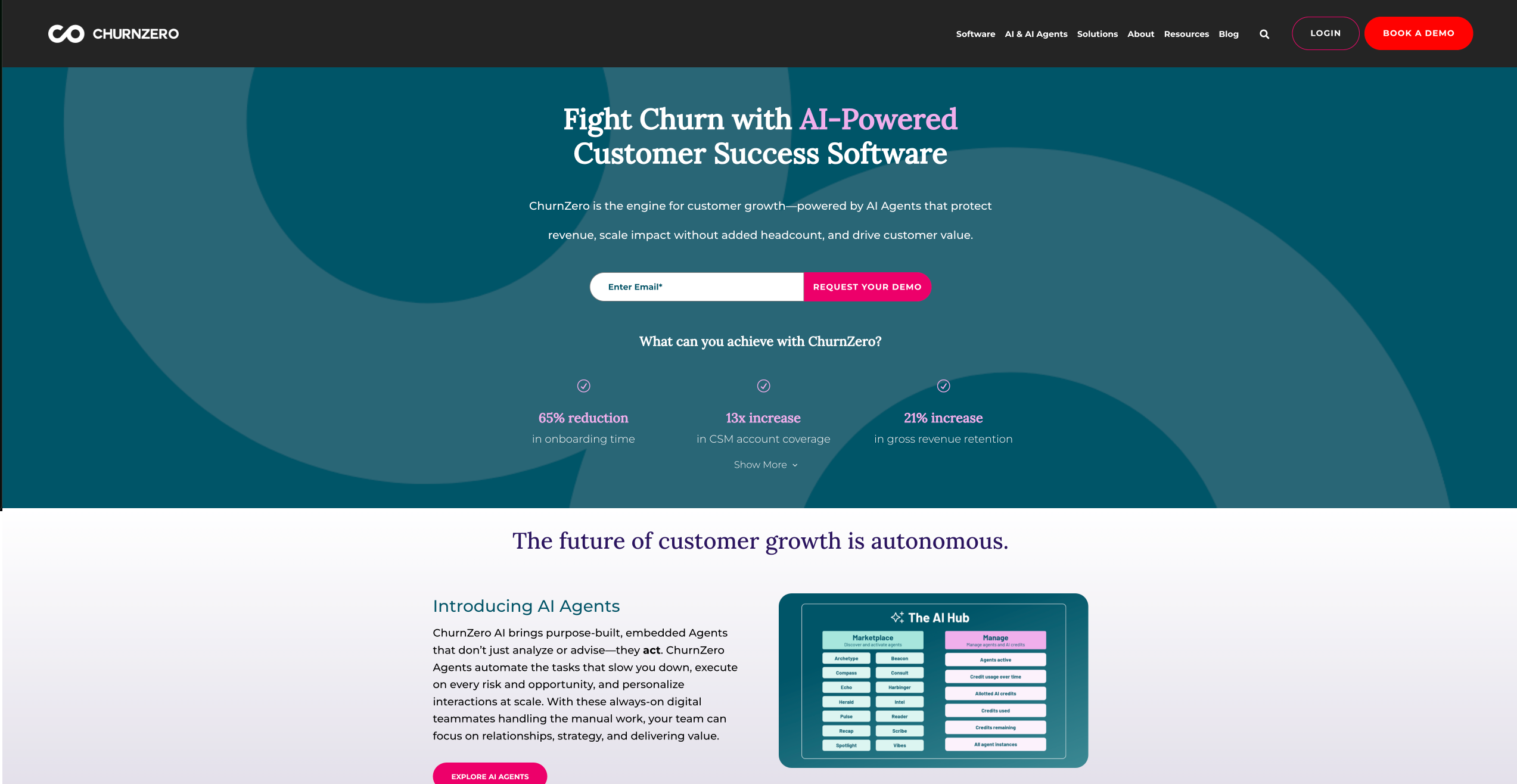
ChurnZero is a full featured customer success platform designed for B2B SaaS teams that want to understand, predict, and manage churn at the account level. It is less about billing and more about customer health, product adoption, and expansion.
Best for:
B2B SaaS companies with customer success teams that need robust health scoring and lifecycle campaigns.
What it does well:
- Account health scoring based on product usage and engagement
- Playbooks that trigger outreach when risk signals appear
- Multi channel engagement, including email and in app
- Revenue focused reporting for CS leaders
ChurnZero often sits alongside a Dunning and cancel flow tool, providing the “CS and adoption” half of the churn story.
4. Velaris
Velaris focuses on proactive churn prevention for B2B SaaS companies by helping Customer Success teams detect risk early through AI-powered account intelligence. It addresses churn through engagement signals, product adoption trends, sentiment analysis, and lifecycle management.
Best for:
B2B SaaS teams that want deeper account intelligence across product usage, conversations, and engagement signals to accurately understand churn risk.
What it does well:
- AI Copilot that answers account-level questions in natural language and surfaces next-best actions
- Automated summaries of calls, tickets, and account activity to reduce manual prep in churn detection
- Low-code integrations through Velaris Bridge to unify CRM, support, product, and conversation data
- Dynamic health scoring that incorporates usage, engagement, and sentiment signals
- Playbooks and workflow automation triggered by risk indicators or lifecycle milestones
Velaris is a strong fit if churn in your business is driven by adoption, engagement, and customer experience gaps rather than purely payment failures, and you want AI to surface risks proactively.
5. Vitally
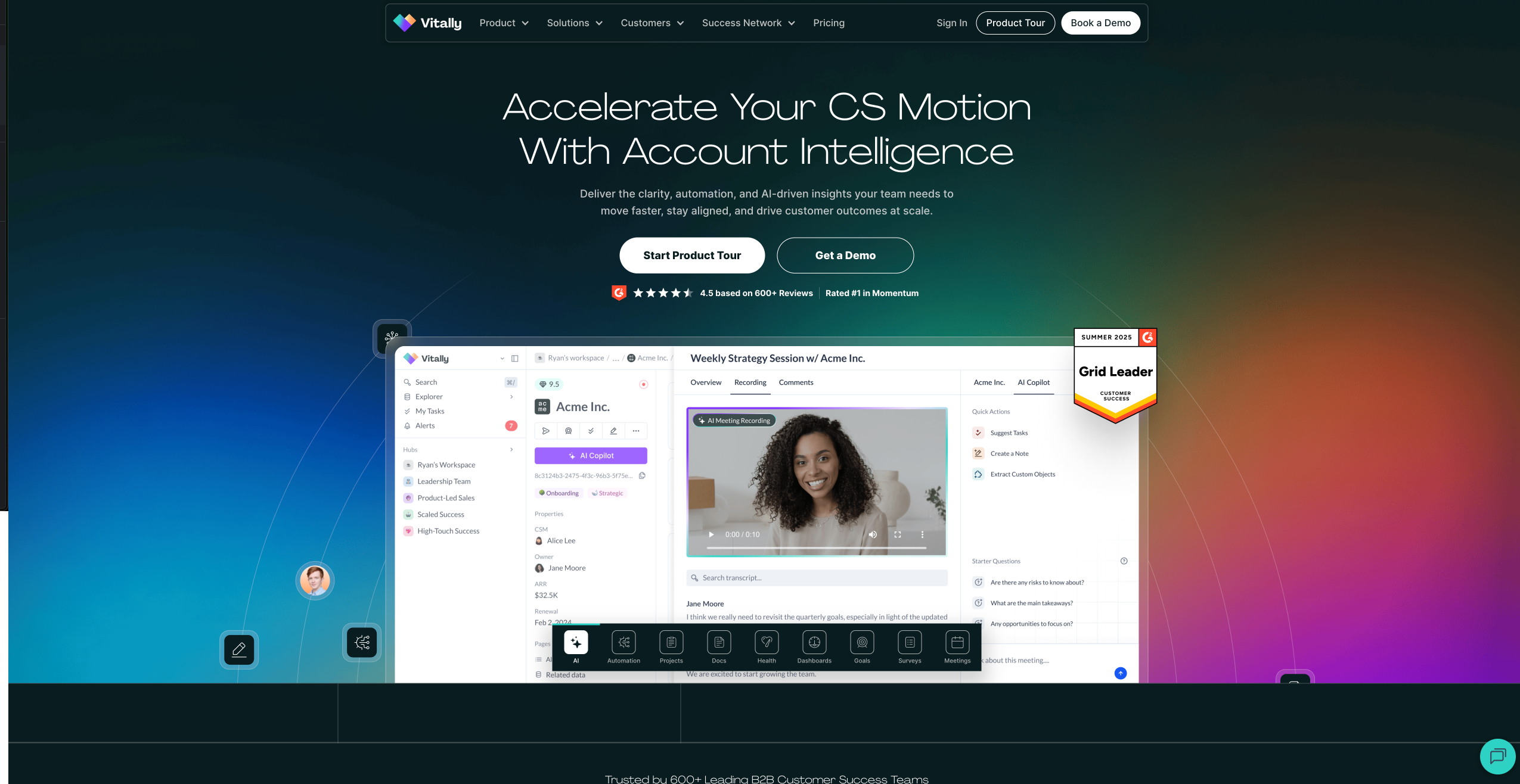
Vitally is another modern customer success platform that provides strong visibility into account health, lifecycle events, and revenue risk for B2B SaaS. It combines product analytics, CS workflows, and reporting so teams can proactively manage churn and expansion.
Best for:
Product led or CS led B2B SaaS teams that want deep customer health views and robust playbooks.
What it does well:
- Customer health scoring with flexible metrics
- Playbooks and tasks for CSMs to follow up with at risk accounts
- Views that align product, CS, and revenue teams around churn risk
- Integrations with CRMs, data warehouses, and analytics tools
Vitally does not replace billing or Dunning tools. Instead, it focuses on the customer success side of subscriber churn management.
6. ProsperStack
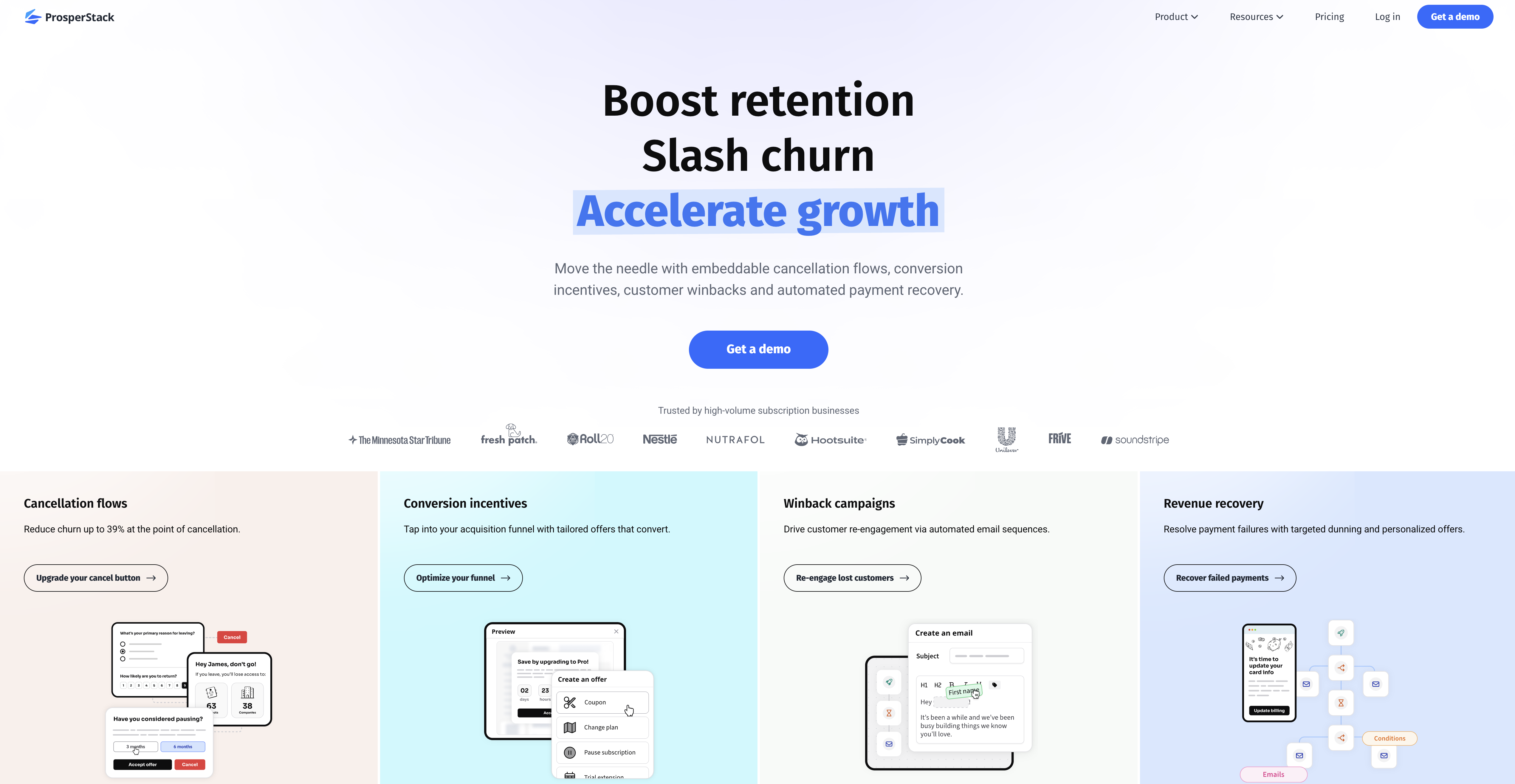
ProsperStack focuses on no code cancellation experiences that help you reduce voluntary churn. It allows you to design cancel modals, test offers, and measure the impact of interventions without engineering work.
Best for:
Subscription businesses that want powerful cancel flows but do not need deep payment recovery features in the same tool.
What it does well:
- Visual cancel flow editor
- Offer testing for things like discounts, pauses, and plan changes
- Integration with billing systems to keep data in sync
- Reporting on saved revenue and churn reasons
ProsperStack is a good fit if cancellations are your main concern and your payment recovery stack is already handled elsewhere.
7. Recurly
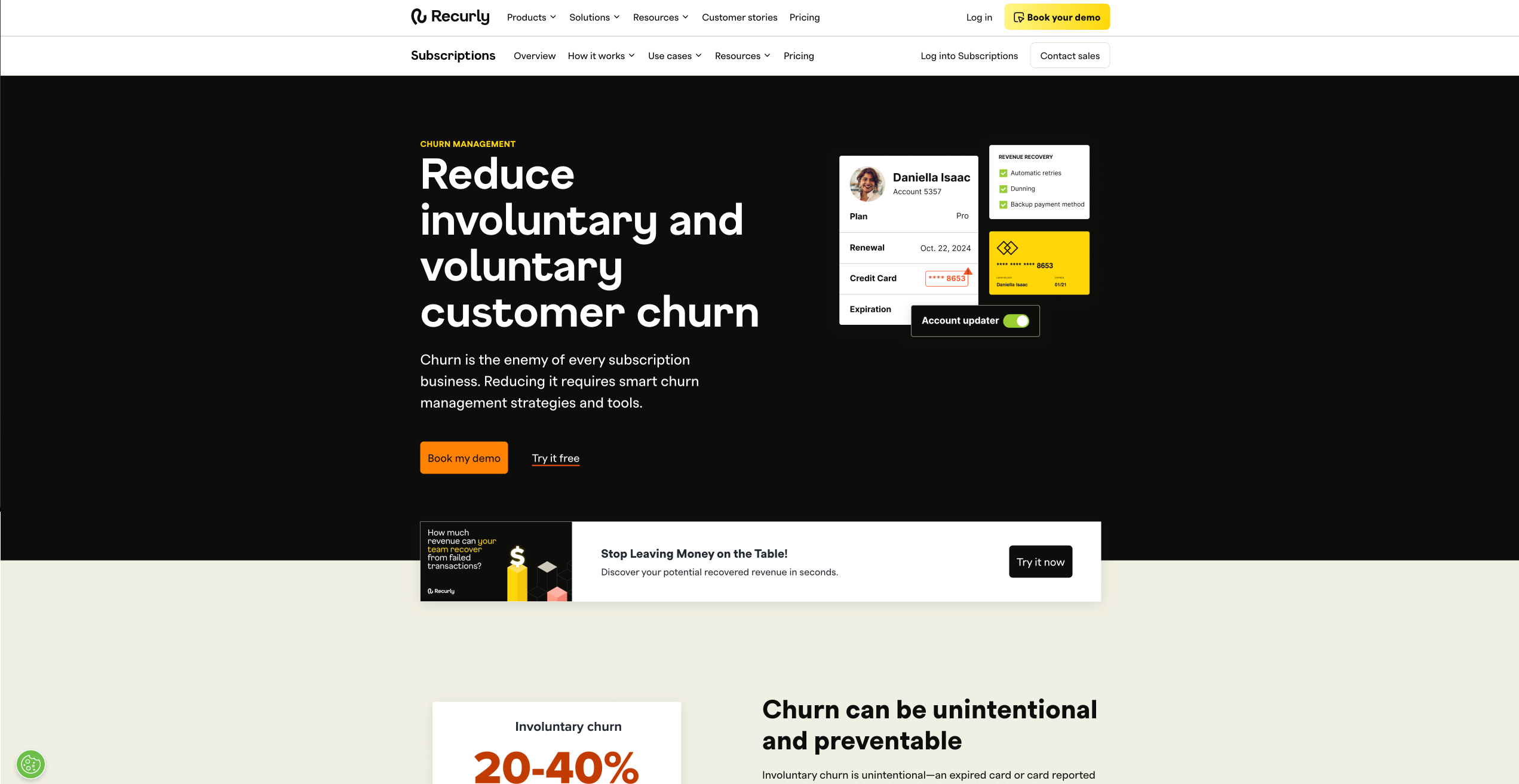
Recurly is a subscription billing platform that includes churn management features as part of its product line. Its tools blend billing orchestration, renewal workflows, and Dunning into a single system.
Best for:
Teams already committed to Recurly for billing that want native churn management capabilities.
What it does well:
- Automated Dunning sequences inside the billing platform
- Revenue and subscription analytics with churn views
- Configuration options for retries and notifications
- Support for multiple payment methods and currencies
Recurly is convenient when you prefer an all in one billing plus churn management stack, although it is less specialized than dedicated tools.
8. Baremetrics
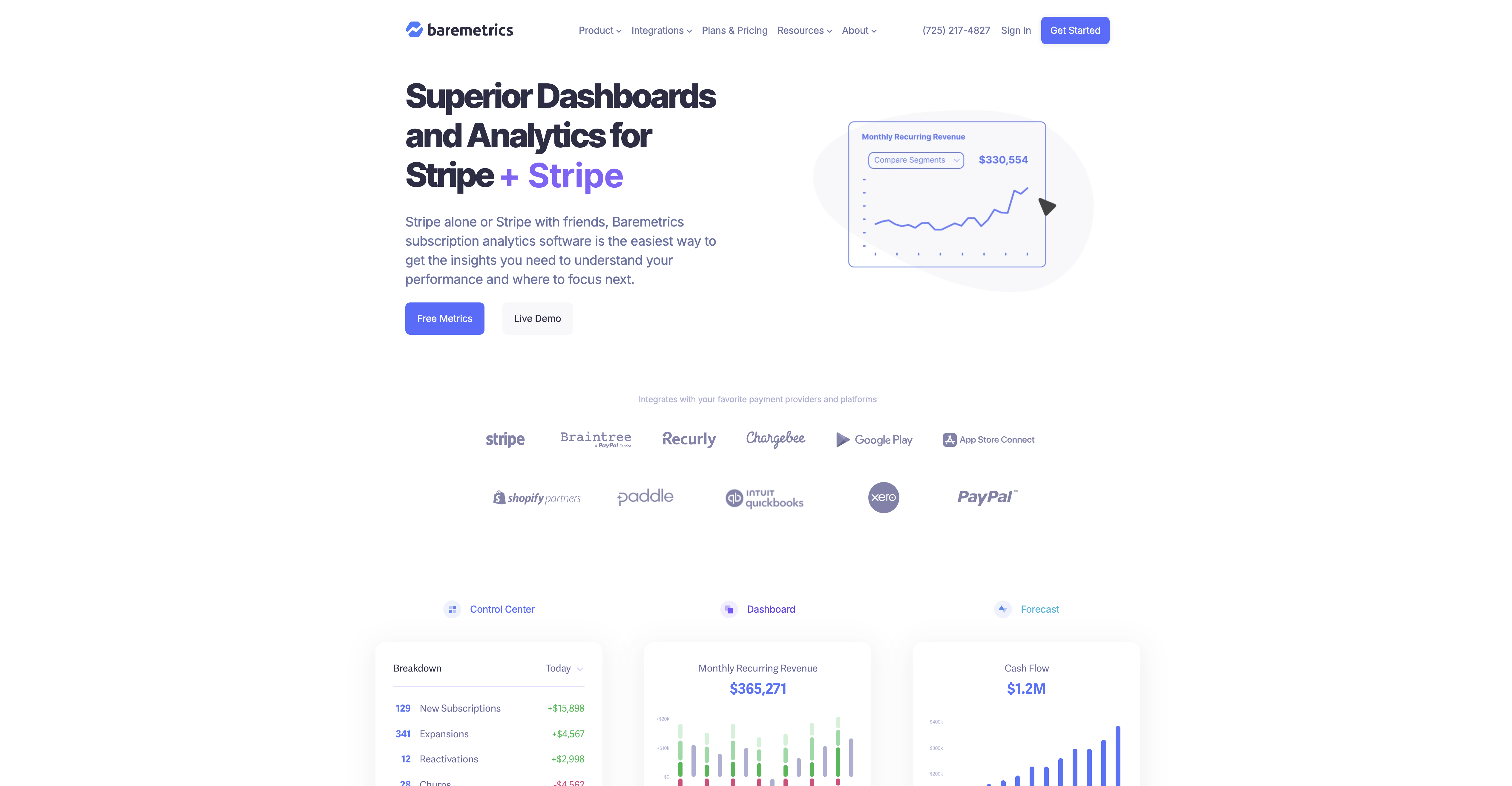
Baremetrics is best known for its subscription analytics, including MRR, LTV, and cohort views. It also offers Baremetrics Recover, a simple Dunning module that sends failed payment emails and reminders for Stripe based businesses.
Best for:
Startups and smaller subscription businesses that want basic churn analytics and straightforward recovery without complex setup.
What it does well:
- Clear churn and retention dashboards
- Basic failed payment email flows for Stripe
- Easy implementation for small teams
- Useful for founders who want visibility without a CSOps team
Baremetrics is often a “first step” in churn management before businesses graduate to deeper Dunning and cancel flow solutions.
Native Platform Tools vs Dedicated Subscriber Churn Management Software
Most subscription platforms now include some level of churn or retention feature set. You will often see:
- Basic Dunning workflows for failed payments
- Simple cancel pages and reason collection
- High level churn and retention reporting
These tools are convenient and designed as “good enough starter solutions” for early-stage businesses. They optimize for simplicity across their entire user base, which makes sense for platforms supporting thousands of diverse customers.
The Limitations of Native Tools
However, native platform tools typically:
- Use one retry schedule for every decline type - Insufficient funds, expired cards, fraud blocks, and network errors all get the same timing, leaving revenue on the table
- Offer limited or generic customer communication - Basic email templates without sophisticated testing or personalization capabilities
- Provide shallow analytics - Cannot separate natural recoveries from campaign-driven lift, making it difficult to measure true incremental impact
- Lack strategic guidance - No help interpreting fluctuations, designing retention strategies, or optimizing based on your vertical and business model
- Create platform lock-in - Switching billing platforms means rebuilding your entire churn management approach
What Dedicated Solutions Provide
Dedicated subscriber churn management solutions, by contrast, focus entirely on retention. That singular focus typically leads to:
- Sophisticated logic and testing capabilities - Decline-code-specific retry timing, A/B testing frameworks, advanced segmentation
- Better multi-channel communication - Branded email sequences, SMS nudges, strategic customer contact optimized for recovery and retention
- Deeper reporting with transparent attribution - Clear visibility into what actually drove improvements versus natural baseline fluctuations
- Strategic guidance on what to do with the data - Expert consultation on interpreting metrics, designing experiments, and implementing proven playbooks
- Platform flexibility - Cross-platform compatibility valuable for businesses operating across multiple billing systems or considering migrations
The Convenience vs Performance Trade-Off
The fundamental trade-off is convenience versus performance.
Native tools are maximally convenient—they’re already included, require no additional integration, and work “out of the box.” For very early-stage businesses with limited recurring revenue, this convenience often outweighs the performance gap.
Dedicated solutions require integration effort and additional investment, but they optimize relentlessly for maximum recovery because retention is their sole focus. Even a 1% improvement in recovery rate can deliver 10x+ ROI when meaningful revenue is at stake.
When to Graduate from Native Tools
Companies typically graduate to dedicated subscriber churn management solutions when:
- Subscription MRR exceeds $200k and every percentage point represents meaningful revenue worth protecting
- They realize native tool limitations are leaving money on the table - Recovery rates plateau, churn remains higher than industry benchmarks
- They want strategic partnership and ongoing optimization, not just software they configure once and hope works
- They need sophisticated capabilities native tools can’t provide - Advanced testing, deep segmentation, vertical-specific playbooks, transparent attribution
- They value platform flexibility - Operating across multiple billing systems or planning platform migrations
For small, early-stage businesses under $50k MRR with minimal churn, native tools can be perfectly adequate. As revenue grows and the dollar value of each percentage point increases, the ROI from specialized churn management usually outweighs the friction of adding a dedicated platform.
The key is matching your solution to your stage. Early on, “good enough” makes sense. As you scale, “optimized for your vertical with expert guidance” becomes a competitive advantage that compounds month over month.
How To Choose The Right Subscriber Churn Management Tool
When evaluating tools, focus on these questions rather than just feature checklists:
What type of churn is our biggest problem right now?
Failed payments, cancellations, lack of adoption, or a mix of all three.
Where does our data already live?
Billing platform, product analytics, CRM, CS tool, data warehouse.
Do we need technology only, or technology plus strategic guidance?
Some teams only want features. Others need a partner who helps interpret data and design experiments.
How will this tool prove incremental lift?
Ask how they separate natural churn changes from the effect of their platform.
What business stage are we in?
Under 50k MRR may be fine with native tools.
Above 200k MRR, even small improvements in churn and recovery can pay for a dedicated solution many times over.
Use these answers to decide whether you need:
- A holistic retention partner like Churn Buster
- A cancel flow specialist like ChurnKey or ProsperStack
- A customer success platform like ChurnZero or Vitally
- Analytics plus simple recovery like Baremetrics
- Predictive insight tools like Churnly
- Or a billing native approach like Recurly
Final Thoughts
Subscriber churn management is not a single feature or a one time project. It is an ongoing discipline that touches billing systems, customer experience, product adoption, and analytics.
The best software platforms help you see where churn is coming from, act on it with targeted workflows, and measure what actually changes outcomes.
Whether you choose a holistic retention partner like Churn Buster or combine several specialized tools, the key is to move beyond “good enough” dashboards and into a deliberate strategy that protects recurring revenue and compounds value over time.